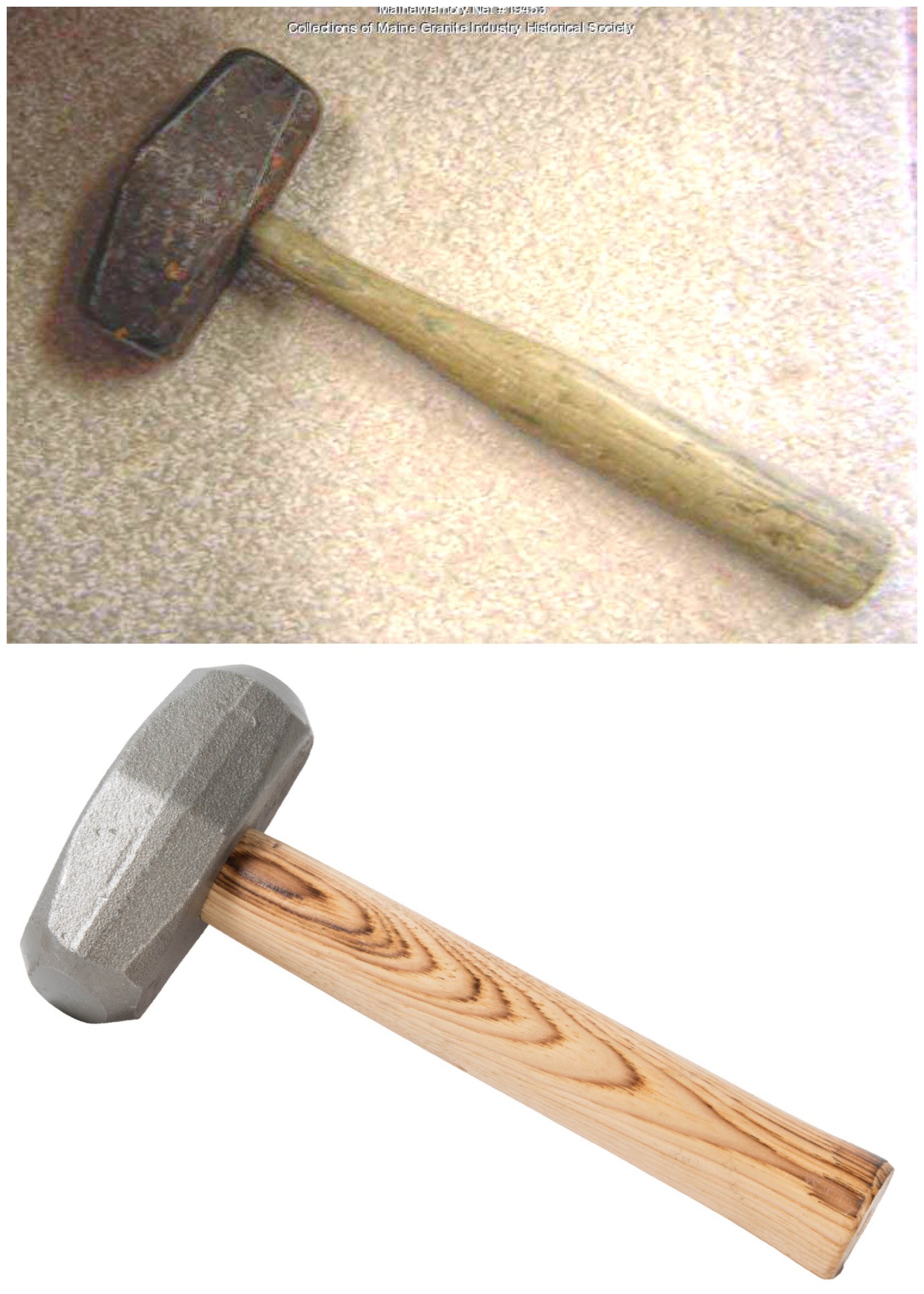
Few tools carry a lineage as sculpted as the drilling hammer. Short-handled, heavy-headed, and built to strike steel against stone. Sometimes known as a plug drill hammer or classic single-jack. This tool helped shape everything from ancient quarries to early American railroads. And while its role has evolved with technology, the spirit of precision striking endures.
The roots of the drilling hammer stretch deep into human history, far earlier than the tool as we know it today:
Ancient Origins
Long before steel or handles entered the picture, early humans broke rock with simple hammerstones, dating back three million years. Civilizations across Egypt, Mesopotamia, and beyond refined those techniques. Egyptians extracted granite for pyramids and obelisks by striking stone with heavy hammers and driving wooden wedges into seams. These wedges often had holes through the center to help workers carry them as they quarried enormous blocks with remarkable precision.
Fire and Stone
From the Roman Empire through the Middle Ages, miners used a “fire-setting” technique to fracture rock: heat the face of the stone with fire, then shock it with water. The rapid cooling cracked the rock, which was then pried apart using hammer and chisel.
17th Century Innovation
In 1683, Saxon blacksmith Hemming Hutman forged a wrought-iron drill tipped with tempered steel. This is considered one of the earliest purpose-built tools for hammer drilling holes in rock. Once the holes were drilled, gunpowder charges became far more effective, revolutionizing mining and quarrying.
19th Century: The Age of Drill-Jacking
By the 1800s, hand drilling had become a craft of its own. The classic hand drilling hammer was typically 2 to 4 pounds on a roughly 10-inch handle. It naturally became the tool of choice for quarry workers, miners, and railroad construction crews. Two common techniques of drill jacking:
-Single jacking: One worker held and rotated the chisel with one hand while striking it with the hammer in the other. The best drillers were ambidextrous, switching sides to extend their endurance.
–Double jacking: One or two workers struck the steel with heavy sledges while a “holder” rotated the bit between blows. Their rhythm had to be perfect to avoid disaster: demanding skill, courage, and patient timing.
Drilling hammers became standard tools of the granite industry, railroad engineers, and early American stoneworkers. These heavy, smooth-faced hammers were simple, durable, and dependable. Forged from American steel and seated on a stout wooden handle.
20th Century: Evolution and Obsolescence
The early 1900s ushered in pneumatic drills. They were faster, safer, and required less specialized skill. As soon as these machines hit the quarries, hand drilling faded rapidly. But not entirely.
Prospectors, homesteaders, and Forest Service crews continued using manual drilling hammers well into the 1940s, long after industry had modernized (Top Picture). Their manuals still documented single jacking and modified techniques, even as double jacking became discouraged for safety.
By the mid-20th century, the term drilling hammer gradually shifted toward what many now call an engineer’s hammer: a short-handled, round-faced striking tool used by mechanics, railroad engineers, and industrial workers.
Yet the shape and purpose remain unmistakably tied to their quarrying roots.
What Drilling Hammers Were Built to Do
Even as names changed, the essential jobs stayed the same:
–Rock Drilling: Driving a chisel or drill steel into stone, one controlled strike at a time.
–Stone Splitting: Striking wedges and feathers to break granite or limestone along clean lines.
–Chiseling and Point Work: Shaping stone, masonry, and hard rock.
–Prospecting: Small-scale drilling for mineral exploration.
Vintage drilling hammers were simple, incredibly durable tools made to endure years of impact against steel and stone.
Council Tool’s Modern Drilling Hammers
At Council Tool, we are sculpting that heritage forward.
While mechanized drilling replaced much of the original work, the need for a compact, powerful striking tool never disappeared. Today, we still forge 3 lbs and 4 lbs hand drilling hammers for craftspeople, masons, metalworkers, and anyone who needs authority in a single blow (Bottom Picture).
Our process continues the traditions that defined the originals:
–Forged American steel for strength and resilience.
–Smooth, round faces for controlled striking.
–Compact hickory handles that balance power and precision.
–Heat-treating and tempering that has been dialed-in over generations of Council Tool craftsmanship.
Whether you call it a drilling hammer, plug drill hammer, or engineer hammer, it remains a tool with purpose and a connection to centuries of stoneworkers, miners, and builders.
A Tool That Built the World
From ancient quarries to railroad cuts, from granite blocks to prospecting holes, the drilling hammer is one of the unsung heroes of human industry. Its design endured not because it was simple, but because it was effective.
As long as people still value precision, durability, and American-made craftsmanship, Council Tool will keep forging them, one hammerhead at a time.
Credit:
“Plug Drill Hammer, ca. 1900” on Maine Memory Network’s website
“Hand Drilling and Breaking Rock for Wilderness Trail Maintenance” on USDA Forest Service website
“Blasting Through the Ages: A brief history of drilling” by Anthony Konya on Pit & Quarry website