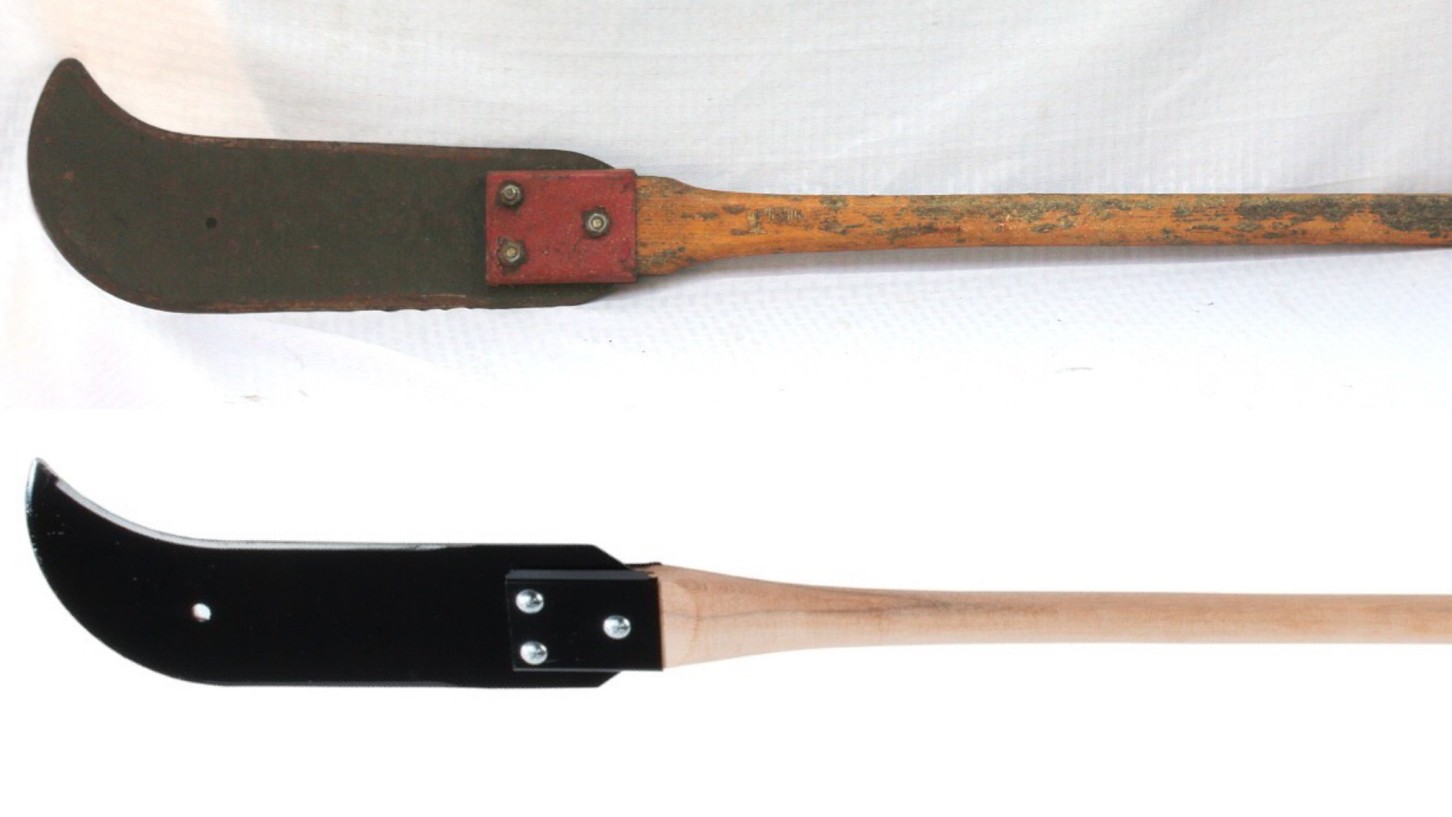
Few edge tools carry a story as rugged as the American landscape they were built to tame. Long before chainsaws buzzed through the brush, there was a tool that carved out trails, tamed briars, and opened the frontier one hard swing at a time…the Ditch Bank Blade.
A hooked, double-edged slasher on a long wooden handle, this tool is the North American cousin of the old world billhook and the British slasher. While the traditional European billhook faded from the American toolkit, its bigger, badder relative survived and thrived across farms, firelines, and surveying crews.
Roots in Brush and Battlefield
Before it was called a ditch bank blade, bush axe, sling blade, or Kaiser blade, early versions were known as fascine knives. These tools were used for cutting brush to build military fortifications in Revolutionary and Civil War America. Settlers and soldiers alike carried hooked cutters for clearing thickets, chopping saplings, and cutting stakes.
By the late 19th and early 20th centuries, American manufacturers began forging two main distinct patterns:
–Bush Hooks with stout, forged blades
–Bank Blades with long, flexible saw-like blades (Top Picture)
Built for Briars, Firelines, Survey Lines, and Field Work
The ditch bank blade earned its reputation because it works hard:
–Clearing dense brush and undergrowth in fields, woodlots, and along ditch banks
–Cutting fireline by early wildland firefighters before chainsaws became standard
–Trimming saplings and small trees
–Surveying work often relies on the ditch bank blade (sometimes called the “surveyor’s brush axe”) to clear lines of sight through thick, tangled vegetation. Its long reach, heavy hooked blade, and slicing action make it ideal for opening up survey corridors where power tools can’t safely or efficiently operate.
–Chopping crop stalks like sorghum for traditional molasses making
-The hooked edge gives the user leverage to pull, rake, and drag aside cut vegetation
It’s the kind of tool that doesn’t need a plug or battery. Just grit, rhythm, and a strong hickory handle.
Made the Council Tool Way
At Council Tool, we still make the ditch bank blade much like the crews of 100 years ago insisted it should be made:
-Heat-treated blade for impact toughness
–Curved, double-edged design for both chopping and slicing
–Long hickory handle, shaped for leverage, control, and safety
–American made craftsmanship, continuing the lineage of traditional brush tools
Council Tool 16″ Double-Edge Ditch Bank Blade, with a 40” American hickory handle and a 16″ high-carbon steel blade (Bottom Picture). Built for heavy-duty brush clearing up to about 2” in diameter.
Cutting Forward
In a world full of power tools, the ditch bank blade still earns its keep. Quiet, capable, and safe for the parts of the land that machines simply can’t reach.
From military roots to modern land-management, from bill hooks to bush hooks, from early settlers to today’s surveyors…the legacy continues in every blade Council Tool produces.
Sources
-Council Tool. 16” Double-Edge Ditch Bank Blade – Product Specifications and Description.
-Axe Wiki. “Sling Blade” – Historical Overview and Tool Characteristics.
-Billhooks.co.uk “Bush Hooks & Brush Axes (USA)” – Historical Context and Variations.