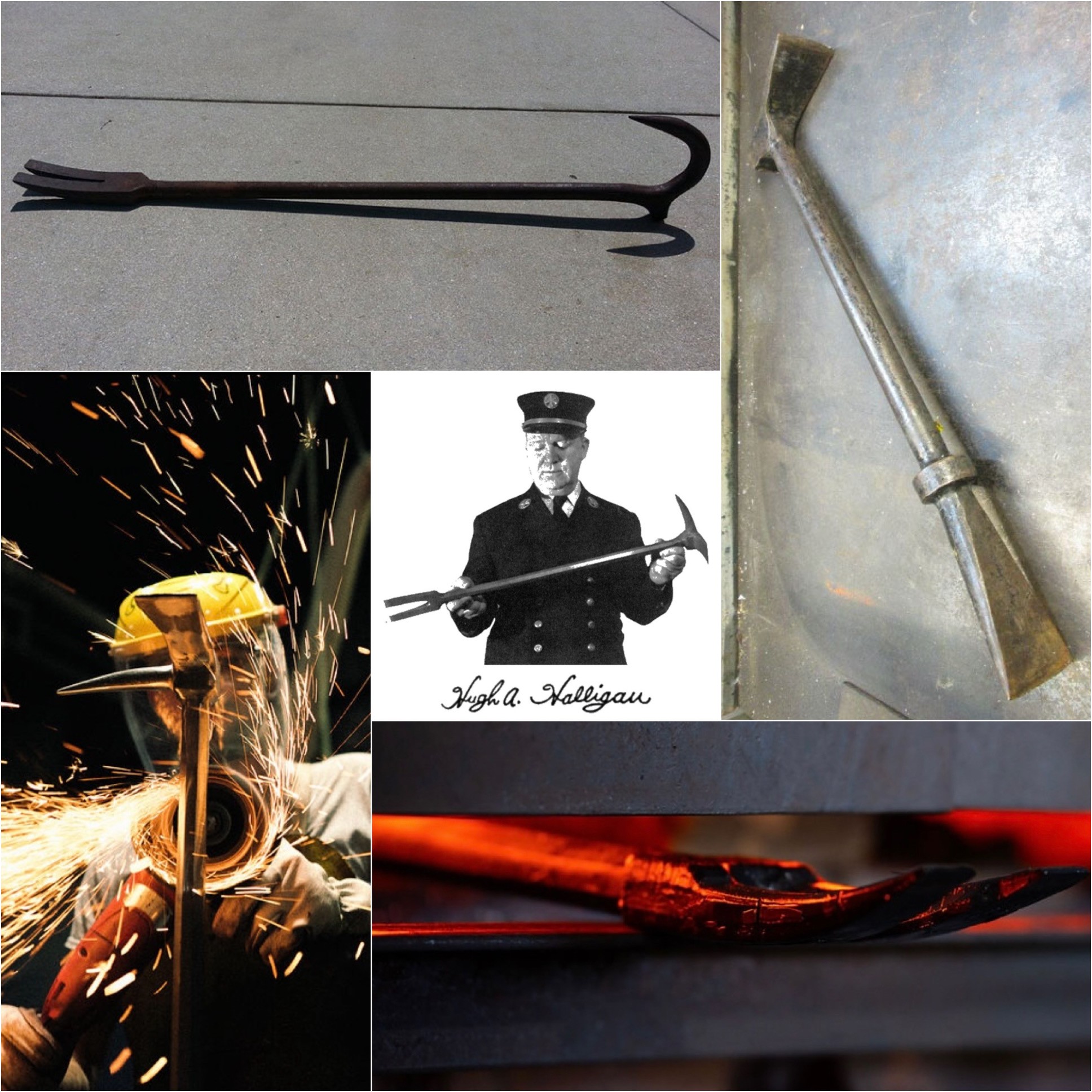
To most people, the Halligan tool is completely unrecognizable. A strange combination of steel ends with no instruction manual. But to a firefighter, it’s irreplaceable. It’s a key, a lever, a lifeline, and often the difference between delay and decisive action. Few tools in the fire service are as universally trusted, as instinctively reached for, or as deeply ingrained in fireground culture as the Halligan.
When it comes to forcible entry tools, few have shaped the fire service the way the Halligan tool has. Born from a need for greater utility, efficiency, and speed, the Halligan stands tall as one of the most indispensable tools on the fireground. A testament to thoughtful design and rugged manufacturing that has carried firefighters through decades of emergency response.
The Roots of Forcible Entry Inspiration
Before the Halligan, firefighters relied on earlier forcible entry tools that paved the way for its invention:
–The Claw Tool (Top Left)
One of the earliest purpose-built forcible entry tools used by FDNY and others, with a hook and fork for prying and pulling. While effective for its time, it was heavy and had an off-center striking surface that posed injury risks.
–The Kelly Tool (Top Right)
Designed by FDNY Captain John F. Kelly, this tool addressed some Claw Tool shortcomings by placing a straight striking surface inline with the bar. Still, it was welded, heavy, and not fully sufficient for all forcible entry needs.
These evolving tools informed the next leap…a multi-functional design that could perform prying, piercing, and striking with greater control and confidence.
Hugh A. Halligan’s Breakthrough Design
In 1948, FDNY Deputy Chief Hugh A. Halligan introduced what would become the definitive forcible entry tool (Center). Drawing directly on the limitations of the Claw and Kelly tools, Halligan conceived a single drop-forged tool made from one piece of high-strength steel.
Combining three functional ends:
–Adze for prying and leverage
–Pike for punching and piercing obstacles
–Fork for gripping, twisting, and leveraging locks and latches
This combination gave firefighters an all-in-one solution capable of facing anything from locked doors to structural challenges, all while being lighter and safer to use than its predecessors.
Because safety and durability were core to Halligan’s vision, he refused to cast the tool. This process was prone to inconsistencies, and instead chose drop forging from a single piece of 4140 high-carbon steel. This ensured reliability under extreme force and established a standard that the industry would follow for generations.
Evolution and Everyday Use
Once introduced, the Halligan tool was quickly adopted across departments nationwide. By the 1950s, companies like the Boston Fire Department were equipping every apparatus with a Halligan, recognizing its versatility and strength.
Over the years, firefighters found more and more uses beyond its original intent as a forcible entry tool. Today the Halligan is used to:
-Open doors and padlocks
-Remove hinge pins or entire doors
-Pry windows and demolish interior walls
-Level and secure ladders
-Turn gas valves
-Lift manhole covers
-Support roof operations and more
It’s adaptability has kept the Halligan relevant even as hydraulic and electric forcible entry tools enter the market. When powered tools fail, the tried-and-true Halligan still gets the job done.
Bill McLaughlin & The Industry Standard
Throughout its evolution, one thing never changed: the commitment to strength and reliability. Whether in early Halligan patterns or modern interpretations, 4140 high-carbon steel drop-forging from a single piece of steel has remained the gold standard. This approach, was championed by generations of fire toolmakers including Bill McLaughlin and other legendary firefighters. Focused on precision forging that ensures that every tool stands up to the rigors of fireground service without fail.
COUNCIL FIRE: Carrying the Legacy Forward
At Council Tool Company, we recognize the Halligan’s place not just in history but in every call, rescue, and moment of truth firefighters face. That’s why we honor the original Halligan principles: one-piece forging, rugged alloy steel, and thoughtful design…in every Halligan tool we produce (Bottom Pictures).
For us, carrying this legacy forward is more than just manufacturing a trusted tool. It’s about respecting the heritage of innovation, supporting those who serve our communities, and ensuring each tool embodies the reliability firefighters deserve.
We are proud to be part of the Halligan’s ongoing story: a story of ingenuity, strength, and steadfast purpose. We don’t take that responsibility lightly. Our Halligan tools reflect not only industry standards but the heart of what forging excellence truly means to us and to the firefighters who depend on them every day.
Source List
1. Fire Engineering — “The Halligan: The Maximum in Utility, Efficiency and Speed”(FireEngineering.com)
2. East Coast Rescue Solutions — “The History and Evolution of the Halligan Tool in Firefighting”
3. FireRescue1 — “How the Halligan Tool Changed the Firefighting Game”
4. FireRescue1 — Tools and Techniques for Forcing a Door / Halligan Origins
5. Wikipedia — Kelly Tool & Claw Tool History