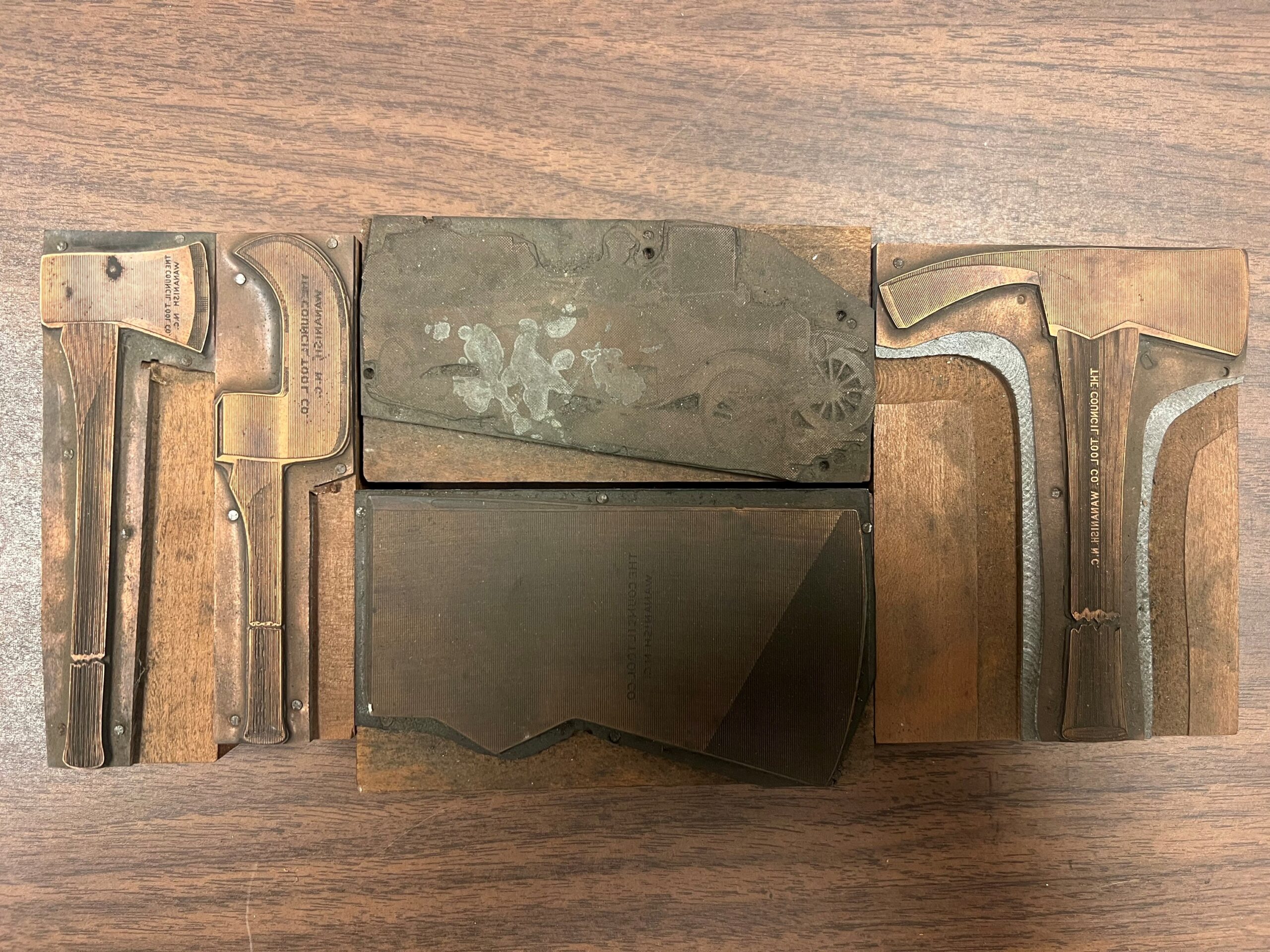
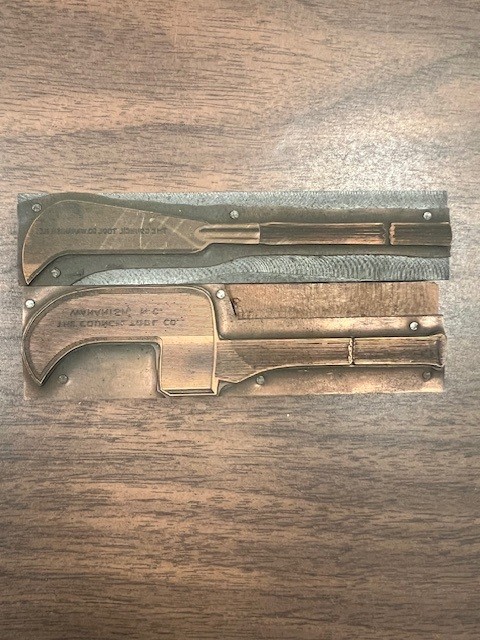
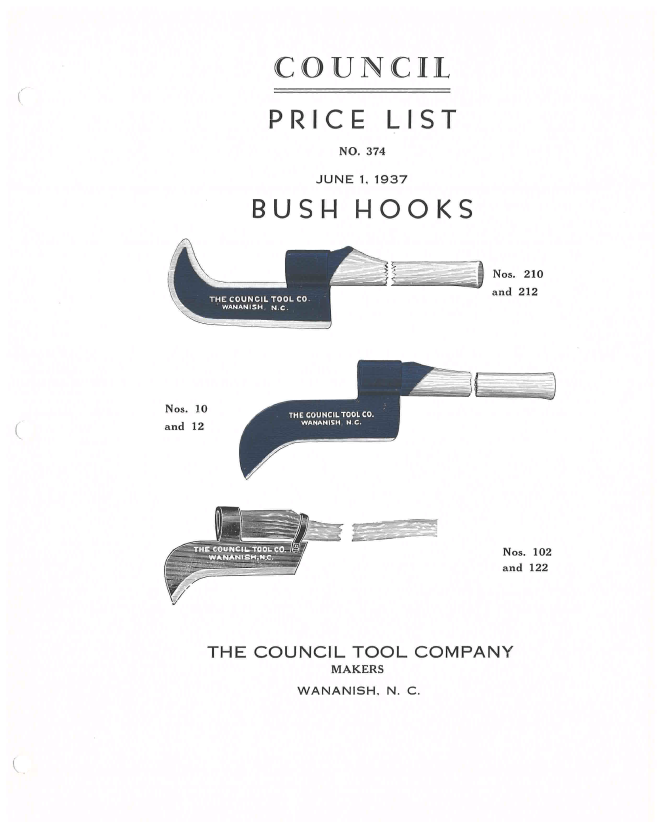
Before pixels, before offset presses, and long before digital layouts, catalogs were built by hand, metal, and muscle. The objects you see here—our original printing blocks—are survivors from that world.
These blocks were used to print detailed illustrations in commercial catalogs nearly a century ago, most likely in the late 1920s or 1930s. They are not just printing tools; they are artifacts of an era when precision, durability, and craft defined mass communication.
What Are These Printing Blocks?
At first glance, they look like sculptural fragments—wood bases topped with finely worked copper shapes. In reality, they are letterpress relief printing blocks, designed to be locked into a press alongside metal type.
The raised copper surfaces carried ink; the recessed areas did not. When pressed against paper, the result was a crisp, tactile image—one impression at a time.
These blocks were especially common in industrial, hardware, and tool catalogs, where clarity and longevity mattered. Copper was chosen over cheaper metals because it could withstand long press runs without degrading.
How Were They Made?
The detail you see wasn’t carved by hand. Instead, these blocks were created using a process called photo-engraving, a cutting-edge technology of the early 20th century.
Here’s how it worked:
- Original Artwork
An illustrator created precise black-ink drawings—often technical in nature—designed specifically for reproduction. - Photographic Transfer
The artwork was photographed to produce a high-contrast negative. - Copper Plate Preparation
A flat sheet of copper was coated with a light-sensitive resist. The negative was placed on top and exposed to strong light. - Chemical Etching
The exposed plate was washed and etched with acid. The acid ate away the background metal, leaving the drawn lines standing proud. - Finishing & Mounting
The etched copper plate was cut into shape and mounted onto a wooden block, bringing it to standard type height so it could print alongside movable metal type.
The fine parallel lines you see in the background are a hallmark of line engravings, not photographic halftones. This technique produced exceptionally sharp images—ideal for catalogs meant to be referenced year after year.
Why These Blocks Matter
By the mid-20th century, offset lithography replaced letterpress for most commercial printing. Blocks like these were often melted down or discarded.
The fact that these survived—still intact, still legible—is rare.
They represent:
- The transition from hand engraving to photomechanical printing
- The golden age of American catalog production
- A time when even mass-produced images required skilled craftsmanship
Today, they remind us that storytelling once involved copper, wood, ink, and pressure—and that permanence was built into the process.